

We teach young people how to use new technologies. But who teaches them how to make the things their grandparents knew by heart? We are teaching AI faster than we are teaching our own heritage.
Somewhere in Europe, knowledge that has travelled through generations is still alive — but only as long as someone continues to practice it.
In Romania, someone still knows how to repair historic buildings using traditional lime mortars and masonry techniques.
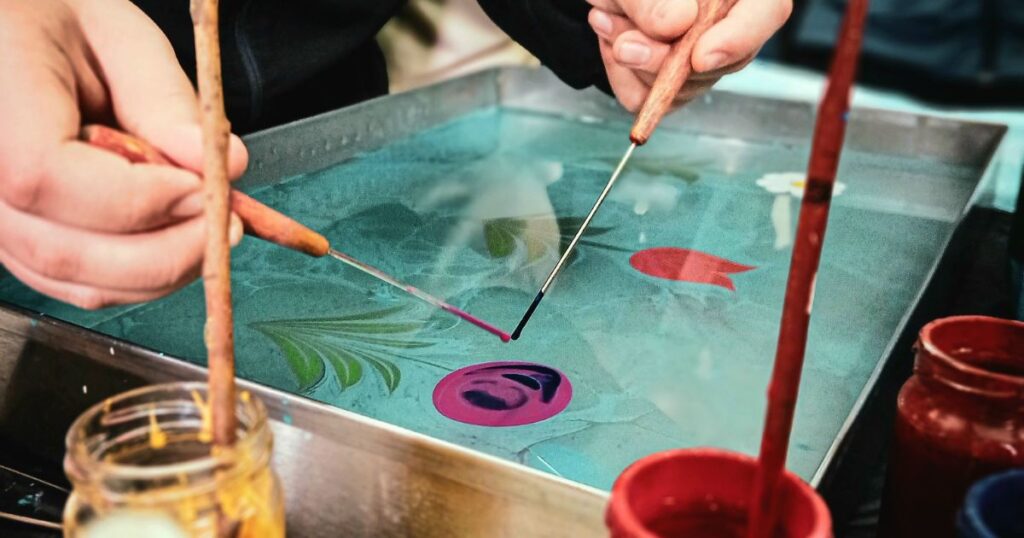
In Türkiye, someone still knows how to transform water into patterns through Ebru, the art of marbling.
In Greece, someone still knows how to create a pair of shoes by hand through traditional shoemaking.
In Spain, someone still knows how to transform clay into objects that carry both function and cultural memory through ceramics.
In Belgium, someone still knows how to give knowledge a lasting physical form through bookmaking and bookbinding.
These are not simply techniques.
They are ways of knowing — built through repetition, observation, mistakes, patience and years of practice. Knowledge that cannot simply be downloaded, generated or replaced.
AI can generate. But can it inherit?
A machine can reproduce an image of a traditional craft, explain the steps and even imitate the final result, but it cannot inherit the knowledge of a grandparent who spent decades working with their hands, learn by watching someone’s hands, feel when the material is ready or decide that a skill is worth passing on to the next generation. That part is up to us.
So, what happens next?
On 3 August, we began designing the Collaborative Apprenticeship Programme (CAP) — a training programme created to bring young people and professional craftspeople closer together.
The programme will combine four areas of learning:
01 — The theory of craft transmission
Understanding how traditional knowledge is passed between generations.
02 — Technical practice
Learning the craft through hands-on experience with professionals.
03 — Digital presence
Exploring how traditional crafts can find new audiences and new relevance in the digital world.
04 — Business development
Helping young people and craftspeople explore how traditional skills can become sustainable opportunities.
The materials are being developed together with young designers and craft professionals, translated into the languages of all partner countries, and made freely available as an open resource for anyone who wants to use them.
Then comes the most important part: putting the knowledge into practice.
The programme will be piloted in each partner country with groups of 6–12 participants, including at least one professional craftsperson — creating a space where knowledge doesn’t just get documented, but actually gets passed on.
Because perhaps the future of traditional craftsmanship isn’t about choosing between technology and tradition. Perhaps it’s about making sure technology helps us keep the human knowledge behind tradition alive.
The question isn’t whether AI can learn from us. It’s whether we will keep learning from each other.
CRAFTWISE is an Erasmus+ project co-funded by the European Union. Through collaboration between five European countries, the project works to preserve and revitalise traditional craftsmanship by connecting experienced craft professionals with younger generations.
Funded by the European Union. Views and opinions expressed are however those of the author(s) only and do not necessarily reflect those of the European Union or the European Education and Culture Executive Agency (EACEA). Neither the European Union nor EACEA can be held responsible for them.